
8.9.3.62 IfcSegmentedReferenceCurve
8.9.3.62.1 Semantic definition
The IfcSegmentedReferenceCurve is a curve defined in the linear parameter space of its base curve that is set in the attribute BaseCurve. The base curve provides a basis for the positioning of the collection of IfcCurveSegment occurrences. A deviating explicit position of a curve segment (IfcCurveSegment.Placement) from the axis of the basis curve produces a superelevation (i.e. depression or elevation from the axis of the base curve). The deviating elevation is defined by the IfcCurveSegment.ParentCurve in the linear parameter space of the base curve. If no deviation in the position of the curve segment to the base curve axis is specified, the axes (Axis and RefDirection) directions of IfcAxis2Placement are interpolated between the initial curve segment placement and the placement of the subsequent curve segment.
The parameterization of IfcSegmentedReferenceCurve is based on the parameterization of the BaseCurve and is not altered by the Segments.
Figure 8.9.3.62.A shows a cross section of a IfcSegmentedReferenceCurve usage for an alignment representation featuring cant with rotation about the low rail and varying superelevation.
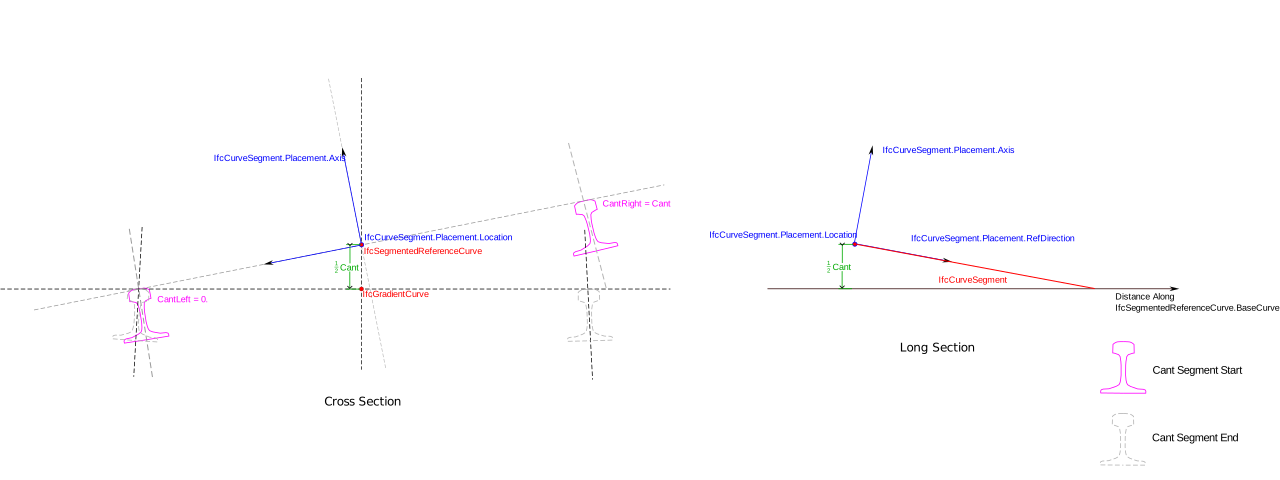
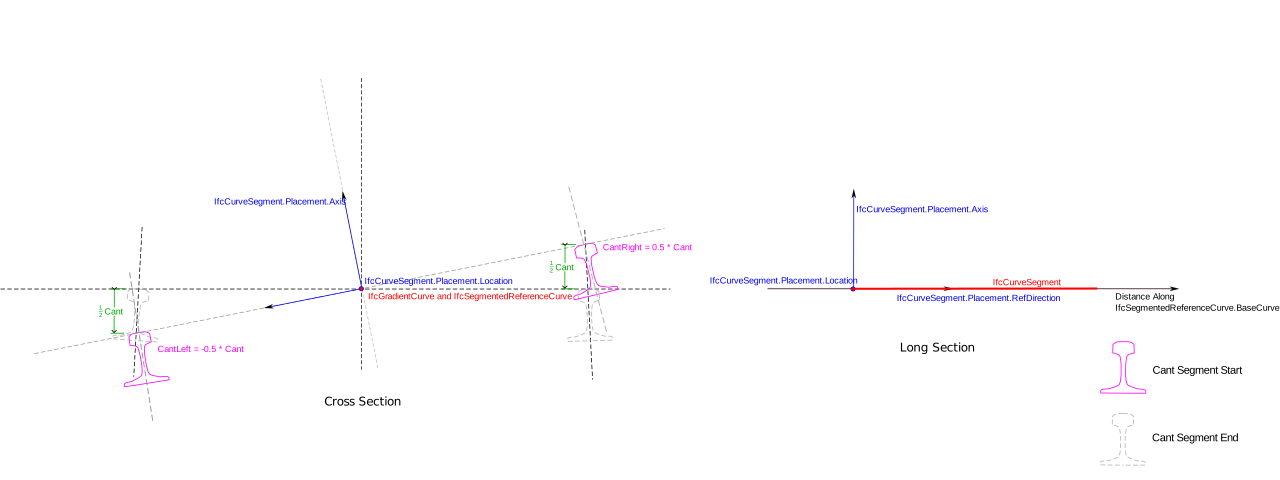
Figure 8.9.3.62.B shows a cross section of a IfcSegmentedReferenceCurve usage for an alignment representation feature cant with rotation about the track centerline with no deviating position.
Informally, a IfcSegmentedReferenceCurve is a curve defined in a “horizontal distance along base curve, deviating elevation” coordinate system. The IfcCurveSegment.ParentCurve defines the change in cross slope between rail heads over the length of the segment. When the IfcCurveSegment.Placement.Location differs from the IfcCurveSegmentPlacement.Location of the next segment, the IfcCurveSegment.ParentCurve also defines the deviating elevation. If the IfcCurveSegment.Placement.Location is the same as for the start of the next segment, the deviating elevation along the length of the segment is constant.
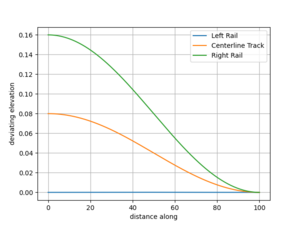
The evaluation of a IfcCurveSegment that is part of a IfcSegmentedReferenceCurve is illustrated by the file in the Examples section below.
8.9.3.62.2 Entity inheritance
-
- IfcCurve
- IfcAnnotationFillArea
- IfcBooleanResult
- IfcBoundingBox
- IfcCartesianPointList
- IfcCartesianTransformationOperator
- IfcCsgPrimitive3D
- IfcDirection
- IfcFaceBasedSurfaceModel
- IfcFillAreaStyleHatching
- IfcFillAreaStyleTiles
- IfcGeometricSet
- IfcHalfSpaceSolid
- IfcLightSource
- IfcPlacement
- IfcPlanarExtent
- IfcPoint
- IfcSectionedSpine
- IfcSegment
- IfcShellBasedSurfaceModel
- IfcSolidModel
- IfcSurface
- IfcTessellatedItem
- IfcTextLiteral
- IfcVector
8.9.3.62.3 Attributes
| # | Attribute | Type | Description |
|---|---|---|---|
| IfcRepresentationItem (2) | |||
| LayerAssignment | SET [0:1] OF IfcPresentationLayerAssignment FOR AssignedItems |
Assignment of the representation item to a single or multiple layer(s). The LayerAssignments can override a LayerAssignments of the IfcRepresentation it is used within the list of Items. |
|
| StyledByItem | SET [0:1] OF IfcStyledItem FOR Item |
Reference to the IfcStyledItem that provides presentation information to the representation, e.g. a curve style, including colour and thickness to a geometric curve. |
|
| IfcCurve (1) | |||
| * | Dim | IfcDimensionCount |
This attribute is formally derived. The space dimensionality of this abstract class, defined differently for all subtypes, i.e. for IfcLine, IfcConic and IfcBoundedCurve. |
| IfcCompositeCurve (4) | |||
| 1 | Segments | LIST [1:?] OF IfcSegment |
The component bounded curves, their transitions and senses. The transition attribute for the last segment defines the transition between the end of the last segment and the start of the first; this transition attribute may take the value discontinuous, which indicates an open curve. |
| 2 | SelfIntersect | IfcLogical |
Indication of whether the curve intersects itself or not; this is for information only. |
| * | NSegments | IfcInteger |
This attribute is formally derived. The number of component curves. |
| * | ClosedCurve | IfcLogical |
This attribute is formally derived. Indication whether the curve is closed or not; this is derived from the transition code of the last segment. |
| Click to show 7 hidden inherited attributes Click to hide 7 inherited attributes | |||
| IfcSegmentedReferenceCurve (2) | |||
| 3 | BaseCurve | IfcBoundedCurve |
The basis curve providing a linear reference system for the segmented curve definition. |
| 4 | EndPoint | OPTIONAL IfcPlacement |
An explicit end placement providing a location and orientation of the segmented reference curve termination point. |
8.9.3.62.4 Examples

8.9.3.62.5 Formal representation
ENTITY IfcSegmentedReferenceCurve
 SUBTYPE OF (IfcCompositeCurve);
	BaseCurve : IfcBoundedCurve;
	EndPoint : OPTIONAL IfcPlacement;
END_ENTITY;